
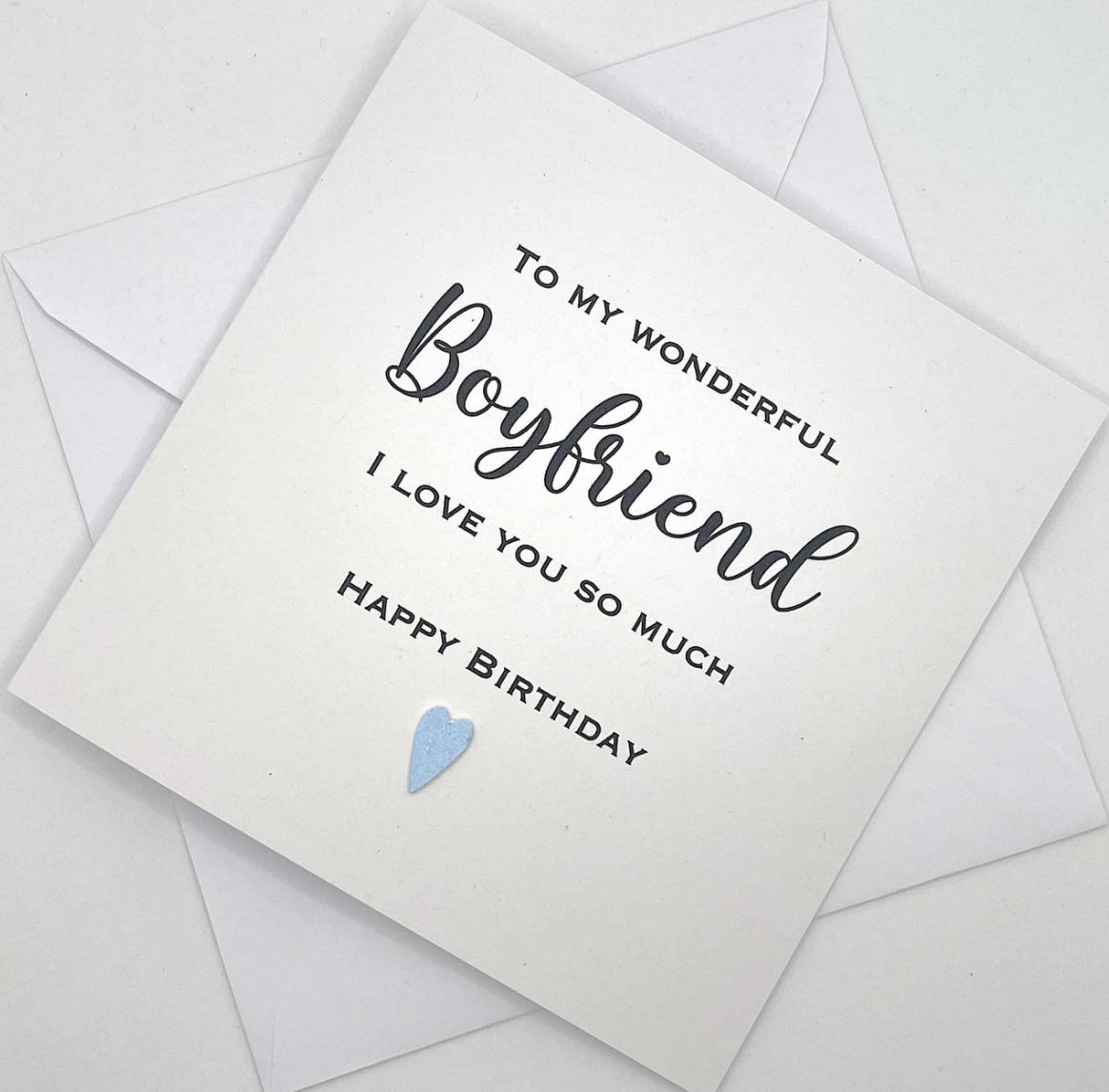
In today’s increasingly digital and social world, handwritten greeting cards, a traditional way of conveying emotions, seem all the more precious. Short love messages for your boyfriend don’t need to be filled with flowery language; the key is to use sincere details to sketch a unique emotional map. An ideal romantic message should be like a carefully crafted perfume: the top note is a captivating sweetness, the middle note carries warm memories of daily interactions, and the base note contains shared expectations for the future. This kind of micro-textual creation requires striking three balances: avoiding excessive cheesiness while maintaining emotional intensity, reflecting individuality while evoking universal resonance, and being concise yet leaving a lasting impression. Modern couple’s greeting card printing has broken through traditional patterns, integrating the fragmented expression habits of social media with the ritualistic feel of physical media, forming a unique way of conveying emotions in this era.
1. Customized Expression Based on Personality Traits
Observing your boyfriend’s personality traits is the first step in creating love messages. For a rational, analytical boyfriend, metaphors like “You are the most perfect algorithm in my life” might resonate more than direct emotional expression; while a romantic, emotional boyfriend is more easily moved by synesthetic phrases like “When I think of you, even my breath is pink.”
Case Study: A boyfriend who loves science fiction received a card that read “You are more important than happiness in all parallel universes,” and set it as his phone wallpaper.
Avoidance Guide: Avoid using stereotypical labels from personality tests; instead, uncover the subtle, little-known traits of your partner.
Advanced Technique: Artistically reconstruct your partner’s catchphrases or habitual expressions. For example, someone who frequently uses “amazing” could write, “Meeting you was amazing.”
2. Content Design for Different Stages of a Relationship
During the honeymoon phase, use bold sensory descriptions: “When you laugh, I hear the sound of stars colliding”; during the stable phase, emphasize deep connection: “The ordinary days we spend together are limited editions I cherish.”
Stage Characteristics: Avoid heavy commitments within the first three months of a relationship; long-term relationships (over two years) need to avoid aesthetic fatigue.
Time Leverage: Anniversary cards can include specific numbers like “This is our 478th morning together.”
Special Turning Points: Long-distance relationships are suitable for incorporating time zone elements: “My goodnight is your good morning, but love knows no time zones.”
3. Romantic Projection of Everyday Scenes
Transforming everyday moments into poetic expressions is most likely to evoke resonance. For example, write about cooking together as: “The tears I shed while you were chopping onions were the seasoning of happiness.”
Scene Discovery: Ordinary activities such as commuting, exercising, and online shopping can all provide romantic entry points.
Sense Awakening: Mentioning the scent of a specific brand of aftershave or the background music of a familiar restaurant are memory anchors.
Contrast Aesthetics: Transform trivial conflicts into sweetness: “Even the way you forget to take out the trash, I want to make a documentary about it.”
4. Creative Use of Cultural Symbols
Cleverly adapting popular culture elements can make sweet nothings more contemporary. For example, a gamer boyfriend might understand the humor of “I’ll permanently collect your heart in my Steam library.”
Generational Differences: For those born in the 1990s, “You are my big round cup of bubble tea” is suitable; for those born in the 2000s, “You’ve surpassed a million favorites in my heart” is more appropriate. Cross-disciplinary Integration: Using scientific terminology in confessions: “Our compatibility is as perfect as a PCR amplification curve.” Taboos: Avoid using memes or outdated internet slang that might evoke negative associations.
5. The Clever Use of White Space
The most sophisticated love confessions often know how to restrain expression. The phrase “It’s raining today” can be more touching than a lengthy emotional statement in a specific context.
Suspense Building: Write “PS: The answer is in the diary on page 37” in the corner of the greeting card to encourage continued interaction.
Imagery Selection: Using “the blue of 4 AM” instead of “I love you” leaves more room for imagination.
Layout Design: Intentionally leaving a cut-off line in the middle of a sentence creates a sense of mystery.
6. Multimodal Expression Innovation
Breaking through the limitations of pure text, combine visual elements to create three-dimensional love confessions. For example, draw a coffee cup and caption it: “You are the concentrated extract that keeps me awake every day.”
Material Experiment: Transparent tracing paper printed with “You can always see through all my disguises.”
Interactive Mechanism: A folded section labeled “Unfold to view the full version of happiness.”
Digital Fusion: A QR code labeled “Scan to get today’s heart-fluttering code.”
7. Cross-Cultural Translation of Love Confessions
Absorbing different cultural expression paradigms can enrich love confessions. The Japanese-style subtlety of “月が绮丽ですね” (The moon is beautiful) and the French-style passion of “Tu es mon trésor” (You are my treasure) are both worth learning from.
Language Game: A mix of Chinese and English: “After meeting you, my life is 99% complete.”
Cultural Substitution: Rewriting the ancient Chinese poem “I only wish your heart were like mine” into a modern version: “I hope our chat history will never need to be searched for ‘explanation’.”
Taboo Avoidance: Pay attention to sensitive numbers or color symbols in certain cultures.
8. Sweet Vision of the Future
Building an emotional future with shared imagination: “When we’re seventy, we’ll still argue about who ate the extra piece of cake.”
Detailed Planning: Specific details like “taking wedding photos at the 7th tram stop in Lisbon” are always more real than empty talk.
Reverse Sentimentality: “If I had to choose amnesia, please let me forget everything, only remember loving you.”
Technological Fantasy: “When brain-computer interfaces are widespread, the first thing transmitted to you will be your current heartbeat frequency.”
As the sunset paints the edges of the card honey-colored, these words complete their transformation from pulp to a vessel of emotion. Creating love quotes is essentially re-encoding memories; every punctuation mark is Morse code for a heartbeat, every blank space is a tacit test of understanding, inviting the other person to fill it in. In an era of rampant fast-paced love, the act of spending thirty minutes carefully crafting thirty words is a confession more moving than any flowery language. Those seemingly simple short sentences contain the latitude and longitude that only you two can decipher, marking the secret coordinates belonging exclusively to two hearts. When you unexpectedly find this card in an old book someday, the yellowed pages will prove once again: all sincere words never truly fade.