
Every item we buy in daily life has a hang tag. These tags often feature attractive colors and embossing, and the printing processes involved are quite sophisticated. So how are they created from a single piece of paper? Let me tell you about hang tag printing processes.
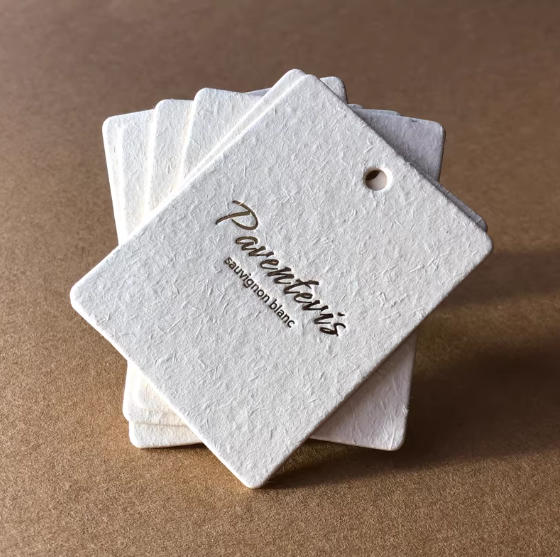
One: Hot stamping (gold and silver) is a heat transfer printing process. Through specific temperature and pressure, the aluminum layer from electrolytic aluminum is transferred to the surface of paper, creating a special metallic effect. Hot stamping can greatly enhance the product’s perceived quality and improve its anti-counterfeiting capabilities. Hot stamping colors include gold, silver, black, blue, and red, among others.
Two: UV curing is a printing process that uses ultraviolet light to dry and cure ink. It adds a layer of varnish to the hang tag, effectively protecting its surface.
Three: Embossing uses a die to deform the printed product under pressure, processing the surface to emboss various patterns, text, logos, etc., giving the hang tag a raised surface and enhancing its texture and three-dimensional effect.
Fourth: Die-cutting. The designed hangtag graphic is made into a die-cutting blade for cutting, so that the hangtag is not only straight-angled and straight-edged, but also has more shapes.